

Have you ever been on a dive and suddenly a majestic, graceful sea turtle glides effortlessly over the reef in front of you? You lock eyes, he tilts his shell towards you, showing off the beautiful pattern, and with a few flaps of his flippers is gone. And you’re left wondering… what was he thinking?
Not a lot, that’s for sure. But they do have a lot going on in those heads of theirs.
Turtles brain size is actually pretty small compared to their body size, and some animal science claims that brain to body ratios correlate with animal intelligence (i.e. sea turtles = not so bright). But while the might not have much going on between the ears (wait, do sea turtles have ears?!), there are many other things they can do that continue to baffle the scientific community. When sea turtles hatch, their brain to body ratio is higher since they are so tiny (and cute, obv.), which some believe is because at that age they are required to do a little more mental work to stay alive. And not many do! Survivorship of hatchlings to adulthood is around 0.1% due to predation, dehydration, and entanglement to name a few. As they grow older their bodies get larger but their brains don’t quite keep up. But their size makes them more difficult to eat and they rely more on their hard shells to protect them, less on their brains. The turtle you saw earlier, tilting his shell towards you? He wasn’t showing off, it was to point his built-in shield in your direction, a signal that he doesn’t quite trust you and to stay away.
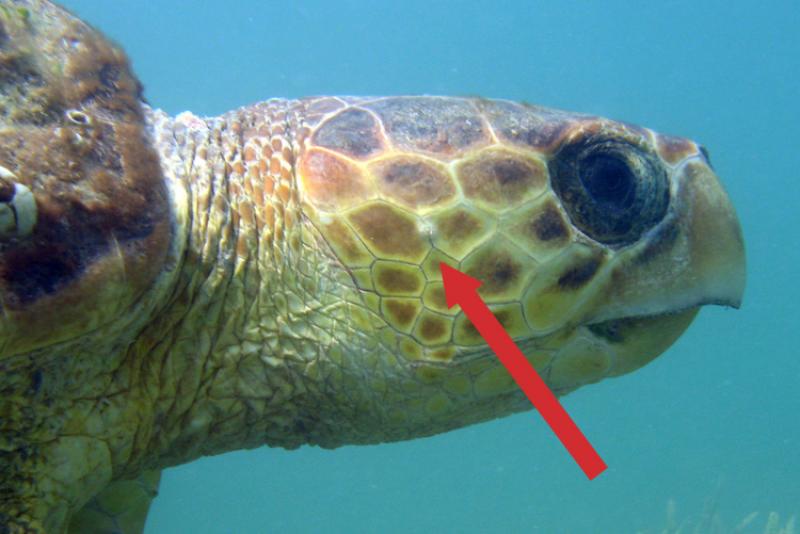 Sea turtles do in fact have ears, often presenting as a small bump just behind the eye. They are covered in a layer of hard scales and a layer of far, which makes them much more attune to hearing sounds (vibrations) underwater than above. Sea turtles are known to be one of the least vocal animals on the planet so they really don’t need to hear much. But they have other senses that are much more important, and much less understood.
They rely on instinct for most of their adult lives, and use other organs and glands to get things done. Just in front of their brain is a pineal gland that it is believed help some species of sea turtles migrate. The gland is located under a thinner area of the skull and detects light in many other species of animals. In mammals the gland is know to regulate circadian rhythms, but in sea turtles its possible that it measures available environmental light and cues the turtle when it is time to head north/south to migrations grounds or feeding grounds.
On either side of their brain – each one being significantly bigger than the brain itself – are the turtle’s two lachrymal or salt glands. These glands help regulate sodium levels in the turtle’s body. Being immersed in the sea 99% of their lives, and not able to rely entirely on their kidneys to excrete any salt from their consumed diets, these glands are constantly discharging salt from their bodies. If these glands ever become clogged or malfunction, elevated sodium levels can cause major neurological damage and even death. So, arguably they are much more important than the brain! You can see them working when female turtles come on land to nest – they look like they are crying as the salt discharges from each eye.
 For their final trick, sea turtles – like migratory birds – have a magnetic sense that is still not completely understood. Even as hatchlings, they can sense the earth’s magnetic field, though at this point it is probably only used only to pick a direction and go. Adults can hone that sense to detect magnetic landmarks and subtle changes in magnetic fields, and use it to find the same nesting grounds year after year – even as the earth’s magnetic field changes! Scientist can prove that the turtles do use and respond to magnetic fields, but have little to no idea physiologically how they do it.
So next time you see a sea turtle, give a little tip of your beanie for how amazing they truly are. And if they flash their shell at you, give ’em a little space.


Leave a Reply
Want to join the discussion?Feel free to contribute!